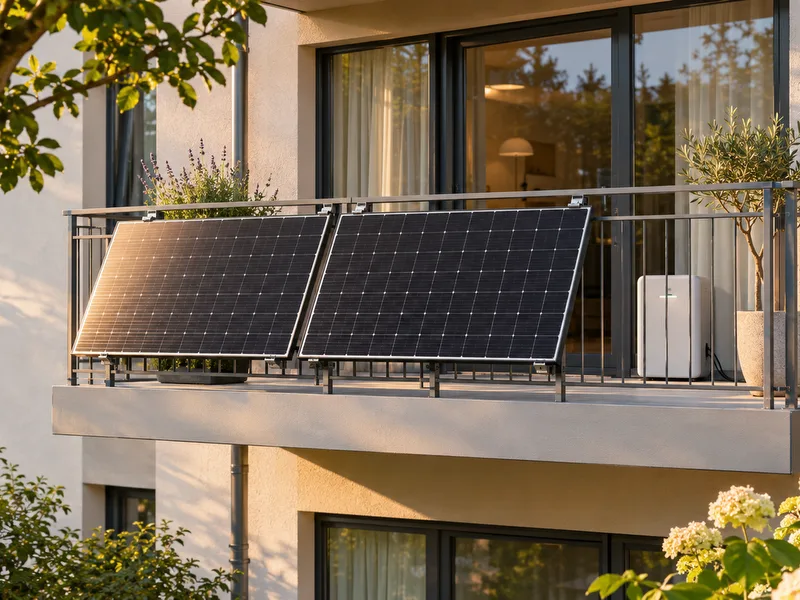
What a battery changes
Without a battery, the kit’s electricity is used there and then by whatever is running. The rest flows to the grid and, in Germany, is recorded with no payment at all 1. In Spain and France the legal treatment of exported power is different and not entirely clear: check the page for your country.
A battery stores that midday surplus and feeds it back into your home once the sun has gone: in the evening, overnight or early in the morning. So it only helps if you genuinely have energy left over during the day.
Types of battery for balcony kits
There are two broad families, depending on where the battery connects, and what makes them useful is how they are controlled.
- DC-coupled: sits between the panels and the microinverter and decides how much power goes through to the inverter.
- AC-coupled or all-in-one: has its own inverter and plugs into a socket. Some can charge from the grid and feed in according to a smart meter. Examples of this category in Stiftung Warentest’s 04/2026 test: Anker Solarbank 3 E2700 Pro, EcoFlow Stream Ultra, FoxESS Avocado Orbit M, Growatt Nexa 2000 and Zendure SolarFlow 800 Pro 2.
- Smart-meter control (a reader on the electricity meter or a meter in the consumer unit): lets the battery feed in only what your base load is using. This is what makes a battery worthwhile.
- Chemistry: most use LiFePO4. We have not checked cycle counts or charge/discharge efficiency on data sheets, so don’t rely on a figure that isn’t on the spec sheet.
- Capacity: typically 1–2 kWh per module, expandable with extra modules. The Stiftung Warentest test used units of about 2 kWh 2.
How much self-consumption goes up
The most quoted figures come from Finanztip, using the HTW Berlin simulator: a home using 3,000 kWh a year, with 2 panels (up to 1,000 W) at 70° on a south-facing balcony, produces 858 kWh a year 34.
Bear in mind that HTW does not publish a ‘typical’ figure; these numbers come from its simulator applied to one case 4. As a no-battery reference, the Verbraucherzentrale estimates that a 400 W panel mounted vertically facing south cuts grid use by about 200 kWh out of 280 kWh generated, roughly 71% 1.
Anker SOLIX, using its own customer data, reports an average rise in self-consumption of more than 50% 5. This is an interested source: a battery manufacturer.
| Self-consumed | Share | |
|---|---|---|
| No battery | 490 kWh/year | 57% |
| With a 2 kWh battery | 770 kWh/year | 90% |
| Difference | +280 kWh/year | +33 points |
Payback: a step-by-step calculation
An illustrative calculation using the figures above. The €0.30/kWh price is an assumption: use your own tariff, in your own currency.
The result leaves out charging and discharging losses, the battery’s standby consumption and any replacement. Once you factor those in, the margin is very tight. Many manufacturers are said to offer 10-year warranties, but we have not checked this model by model.
Prices also vary by source: the Verbraucherzentrale quotes €500–1,000 extra for a battery 1, Stiftung Warentest €700–1,000 2 and Finanztip €300–1,500 3.
What other calculations say
The HTW tool gives payback periods of over 10 years with a battery and shorter ones without 5.
A study by EUPD Research with Anker SOLIX (2025) puts it at about 4 years (2 kW of panels + 2 kWh of storage) or about 5 years (1 kW + 1 kWh, 1,000 kWh/year scenario) 5. It was carried out with a manufacturer, and some critics find its assumptions unclear, so treat it with caution.
When it pays and when it doesn’t
According to Finanztip, a battery only makes sense if all of these apply at once 3:
- You use about 2,500 kWh a year or more.
- Most of your use is in the morning, evening or overnight.
- You have a system of at least about 1,000 W that regularly produces a surplus.
- The Verbraucherzentrale agrees: the more you use and the more panels you have (2 or more), the more sense it makes 1.
- With a single panel, someone at home all day, or hardly any surplus, a battery just stretches payback.
- There are non-financial reasons too: some models offer emergency backup 1.
What the 2026 test found
Stiftung Warentest tested 5 batteries for balcony kits in 04/2026. None was rated ‘good’ (‘gut’); 3 were rated ‘poor’ (‘mangelhaft’) for electromagnetic compatibility (EMC), and water got into the plug on 4 out of 5 2.
The full report is behind a paywall; these results come from a public summary of the test.
RulesUnder review
In Germany, the DIN VDE V 0126-95 standard for plug-in solar does not cover systems with a battery; the requirements are still being drawn up 67. The Verbraucherzentrale points out that a battery may also need registering 1.
For Spain, France, Poland and the UK we have not found battery-specific rules for balcony kits. Before buying, check the rules page for your country and, if in doubt, ask your network operator or an installer.
Sources
- Verbraucherzentrale – Steckersolar: Solarstrom vom Balkon direkt in die Steckdose
- Stiftung Warentest – Speicher für Balkonkraftwerke im Test (04/2026)
- Finanztip – Balkonkraftwerk (Stand 19.11.2025)
- HTW Berlin – Stecker-Solar-Simulator
- Solarserver – Studie zur Wirtschaftlichkeit von Balkonkraftwerk mit Stromspeicher (07.04.2025)
- ADAC – Balkonkraftwerke: DIN VDE V 0126-95 (21.01.2026)
- DKE – Normauslegung zur DIN VDE V 0126-95official