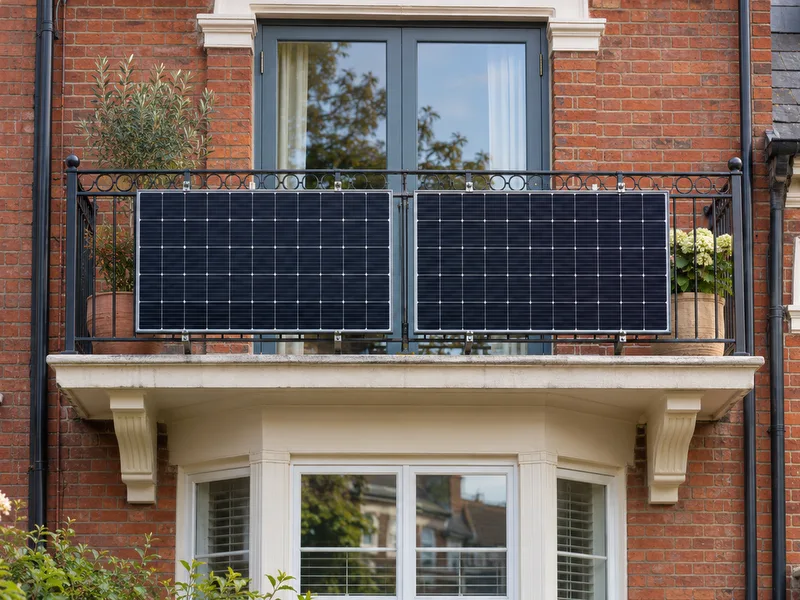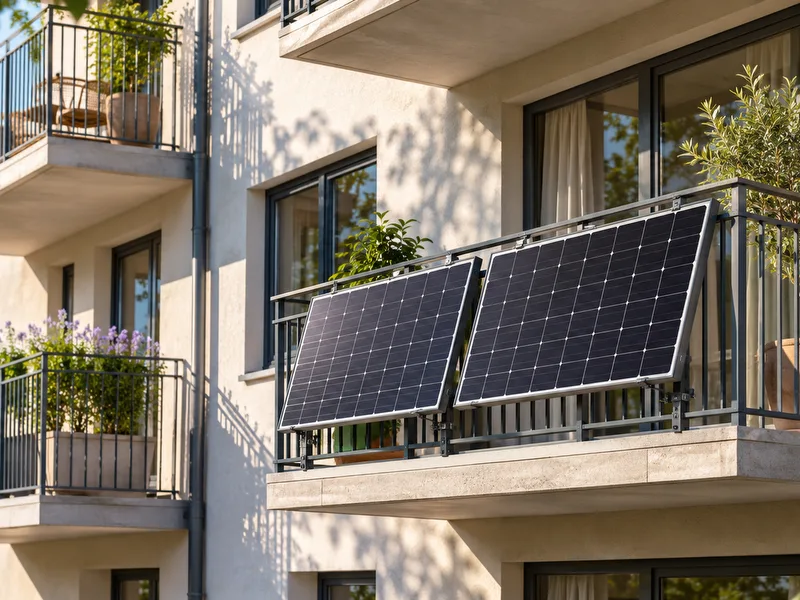
Orientation and tilt
The table compares each set-up with a panel facing south at 30°. It is our own calculation with PVGIS, the European Commission Joint Research Centre’s tool, run on 6 November 2026 without local shading 1.
Vertical panels lose more in southern Spain because the summer sun is higher there. According to the Verbraucherzentrale, south at 30° gives the highest annual yield; a vertical mount trims the summer peaks and helps in winter 2.
The same source advises against recessed balconies, balconies under another balcony, heavily shaded ones and anything facing between north-east and north-west 2.
Treat the percentages as a guide. For your own balcony, enter your angle and orientation in PVGIS 1.
| Set-up | Southern Spain | Central Europe and UK |
|---|---|---|
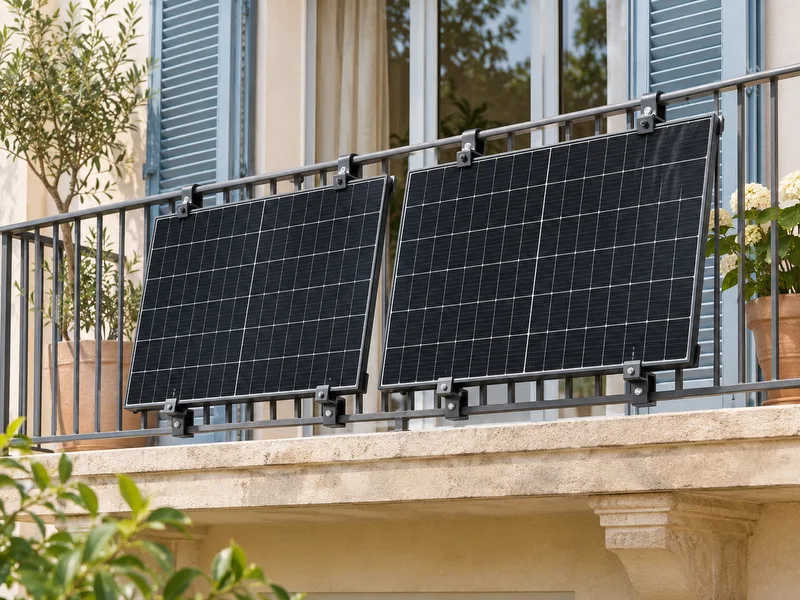
| South, vertical (railing) | −33 to −36% | −26 to −28% |
| East or west, vertical | −50 to −55% | −48 to −51% |
| Flush against the façade (less ventilation) | a further −3 to −5% | a further −3 to −4% |
Shade
A few per cent of shaded surface can reduce output by more than 50% 2. Stiftung Warentest included partial shading and simulated leaves when rating the kits’ yield 3.
A microinverter with 2 independent MPPT inputs keeps the effect of shade to the panel that is shaded.
Panel type: bifacial on a railing?Under review
One manufacturer quotes a bifacial gain of 5–25% depending on albedo (how much light the ground reflects) and tilt 4. A Heriot-Watt study (2023) finds the largest bifacial gain in vertical panels, 22–47% (around 25% at albedo 0.2), but compared with a monofacial panel that is also vertical 5.
On façades the published gains are modest: about 5% for glass-glass façades and up to 6.1% for sunshades in front of a reflective wall (0.7), as cited in a 2025 study on bifacial balustrades 6.
On a railing the back of the panel faces into the balcony, which is often dark or shaded. Our cautious estimate: a small, single-digit gain, unless the floor is light-coloured or it sits on a roof terrace. We found no field measurements on balconies.
Flexible (ETFE) panels are lighter but usually deliver less power per m². We have not verified degradation data, so don’t trust figures that aren’t on a datasheet.
What to check on the microinverter
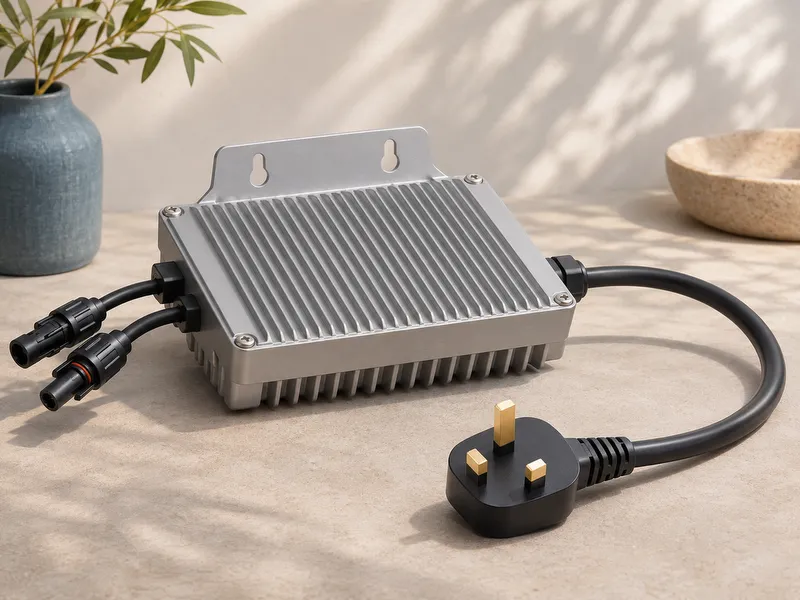
The microinverter turns the panels’ direct current into alternating current and synchronises it with the grid. Go through these points on its datasheet. The Hoymiles data we cite comes from distributors, not from an official manufacturer datasheet 9.
- Output: 600 or 800 VA. Some ship limited to 600 W and are raised to 800 W in the app 7. In Germany, DIN VDE V 0126-95 sets a maximum of 800 W for the inverter and 960 Wp of panels on a standard household (Schuko) plug 82.
- Certificates: EN 50549-1 (connecting generators to the European low-voltage grid). For Germany, VDE-AR-N 4105:2018 with a unit certificate and an NA-Schutz certificate (integrated grid and system protection); for Spain, UNE 217002 / NTS; for France, VFR / UTE C15-712-1 79.
- UK: the device must comply with G98 and the model must be on the ENA register. Until G98 is amended, only one device per household is allowed 1011.
- France: several websites say NF EN 50549-10 is mandatory for inverters connected from 1 July 2026. This is a secondary source and we have not verified it with an official one.
- Electromagnetic compatibility (EMC): in Stiftung Warentest’s test of balcony batteries (04/2026), 3 of 5 units failed because of electromagnetic interference 12.
- Efficiency: around 96.5–97% peak in common models 79.
- Ingress protection: IP67 in the models we checked 79.
- Warranty: 12 years is standard 79.
Mounts for your type of balcony
In Stiftung Warentest’s 06/2025 test of 8 kits of 800 W, 5 failed, almost always because the mounts weren’t stable enough, not because of the panels or the inverter; in one case the mount punctured a panel 3. The results come via the press, as the full report is paywalled.
A panel weighs over 20 kg, and if it falls from a balcony it endangers anyone below. Wind must not damage or loosen it 2.
The UK specification requires the mounting system to be part of the kit, bans fixing it only with cable ties, rope, tape, bungee cords or straps, and requires wind and snow loads to follow Eurocode 1 (BS EN 1991-1-4 and 1-3). It also bans installation on façades with ACM, MCM, HPL or timber cladding 10.
- Metal railing: hooks or clamps rated for your railing’s cross-section; never cable ties alone 10.
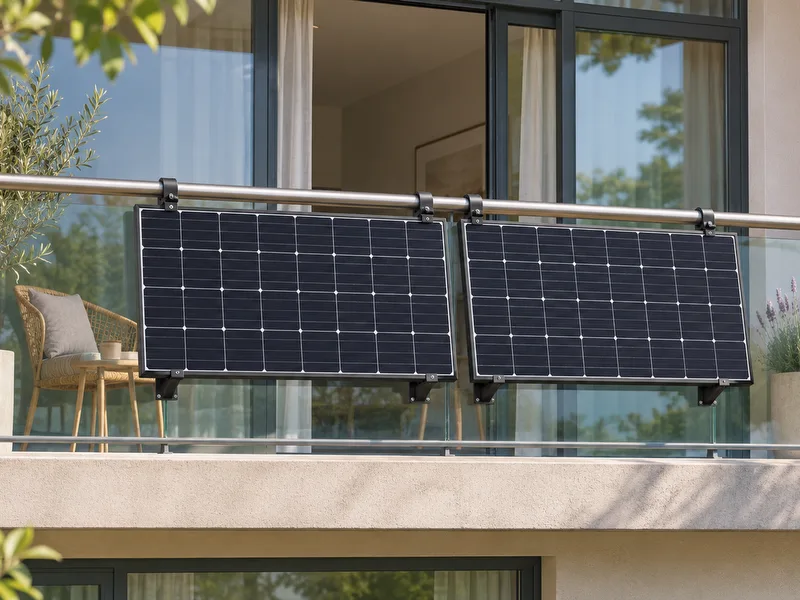
- Glass or wooden railing: high risk. In the UK, wooden balconies are ruled out 10. Ask the mount manufacturer and your landlord or building management.
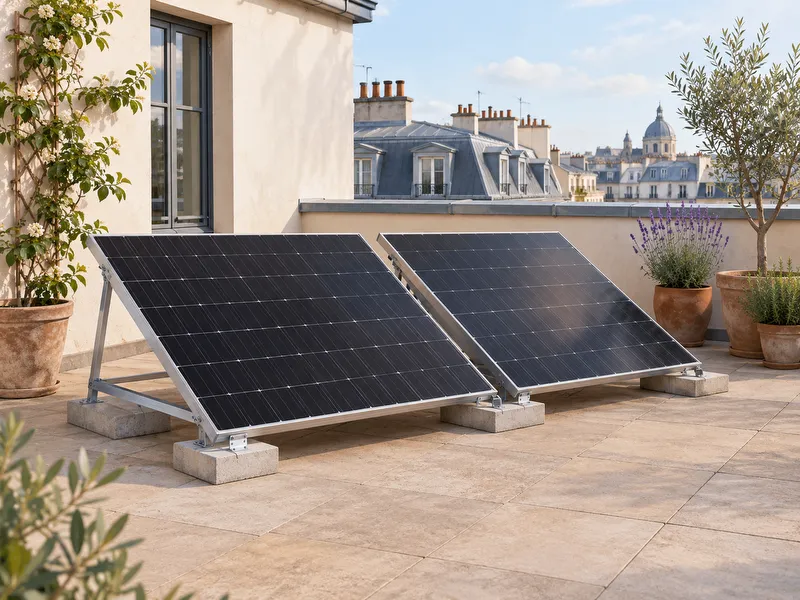
- Balcony floor or flat roof: a triangular stand with ballast. Don’t block exits or escape routes; the UK specification requires a warning about this 10.
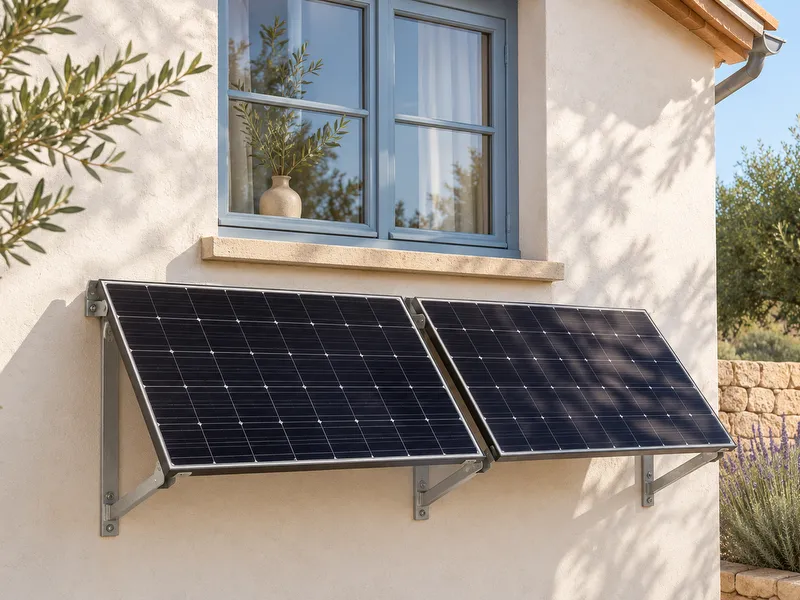
- Façade: a permanent fixing, so you will normally need permission from the owner or the building’s owners.
Indicative prices in 2026
Each price comes with its source and date. The rows for Spain, the UK and Poland come from secondary sources (shops, aggregators or blogs) and are only a guide; the Polish figure has no reliable source. We have no reliable prices for France.
In Germany private buyers pay 0% VAT on these kits 2. The Verbraucherzentrale gives €200–300 for a 2-panel kit and a payback of 3–5 years 2; Finanztip gives 3–7 years with electricity at 30 euro cents/kWh 13.
| Market | What | Price | Source and date |
|---|---|---|---|
| Germany | 1 panel (~450 Wp), online shops | €220–320 (average €277) | Finanztip, 19 Nov 2025 13 |
| Germany | 2 panels (~900 Wp) | €340–440 (average €392) | Finanztip, 19 Nov 2025 13 |
| Germany | 800 W kits tested | ~€329–515 | Stiftung Warentest 06/2025, via the press 3 |
| Germany | Mounts | +€50–100 per panel | Verbraucherzentrale, checked 6 Nov 2026 2 |
| Germany | Battery, ~2 kWh (optional) | ~€700–1,000 | Stiftung Warentest 04/2026 12 |
| Spain | 800 W kit (2 rigid or 4 flexible panels) | ~€450–900 | Leroy Merlin / Amazon.es, checked 2026 14 (secondary) |
| UK | Complete 800 W kit | ~£390–800 (retail range £400–1,300) | Shops and aggregators, Sep–Oct 2026 15 (secondary) |
| Poland | 800 W kit | PLN 2,700–3,250 | Blogs, May 2026 (secondary, no reliable source) |
Warranty
Check who actually gives the warranty (the manufacturer or the retailer) and whether it also covers the mounts.
- Panels: a linear power warranty of 25–30 years and a product warranty of 12–25 years, depending on the model 4.
- Example of a linear warranty on a current TOPCon datasheet: −1% in the first year and −0.4% a year up to 30 years, i.e. at least 87.4% of rated power after 30 years 4.
- Microinverter: 12 years is standard; some distributors offer an extension 7.
Spain, France and Poland: zero export and notificationUnder review
This section is under review: we could not confirm it with official sources, and the secondary sources contradict each other.
Spain: there is no specific rule for plug-in kits; Royal Decree 244/2019 on self-consumption applies. Secondary sources say you need a no-surplus (zero-export) mode or registration with a CIE, and that registration is handled by each region. We have not checked this with MITECO, IDAE or OCU. If you buy in Spain, see whether the kit offers a zero-export mode.
France: several sources say you need a CACSI with Enedis (free, online) and that “no injection” means under 10 W on average over 30 minutes; some add that NF C 15-100 advises against plugging into a socket. The legal references contradict each other.
Poland: sources disagree on whether you must notify the distribution system operator (OSD) for a kit of up to 800 W. We found no official source (URE or OSD).
Sources
- JRC – Photovoltaic Geographical Information System (PVGIS)official
- Verbraucherzentrale – Steckersolar: Solarstrom vom Balkon direkt in die Steckdose
- Stiftung Warentest 06/2025: Balkonkraftwerke 800 W (Bericht photon.info)
- JA Solar – JAM54D40 LB BF
- Heriot-Watt – Bifacial vs monofacial at various albedo (Energy and Built Environment, 2023)
- Vertical bifacial PV balustrades (Renewable Energy, 2025)
- APsystems EZ1-S / EZ1-M – Datasheet EMEA
- ADAC – DIN VDE V 0126-95 für Balkonkraftwerke (21.01.2026)
- Hoymiles HMS-800-2T – pvundso.de (distributor)
- DESNZ – Plug-in Solar Device Interim Product Specification v2.0 (07-2026)official
- Ofgem – Decision to approve DCRP/MP/26/02: proposed amendment to facilitate plug-in microgeneration (G98)official
- Stiftung Warentest – Speicher für Balkonkraftwerke im Test (04/2026)
- Finanztip – Balkonkraftwerk (Stand 19.11.2025)
- Leroy Merlin – Paneles solares para balcón
- Balcony Solar Guide – 800W plug-in solar kits