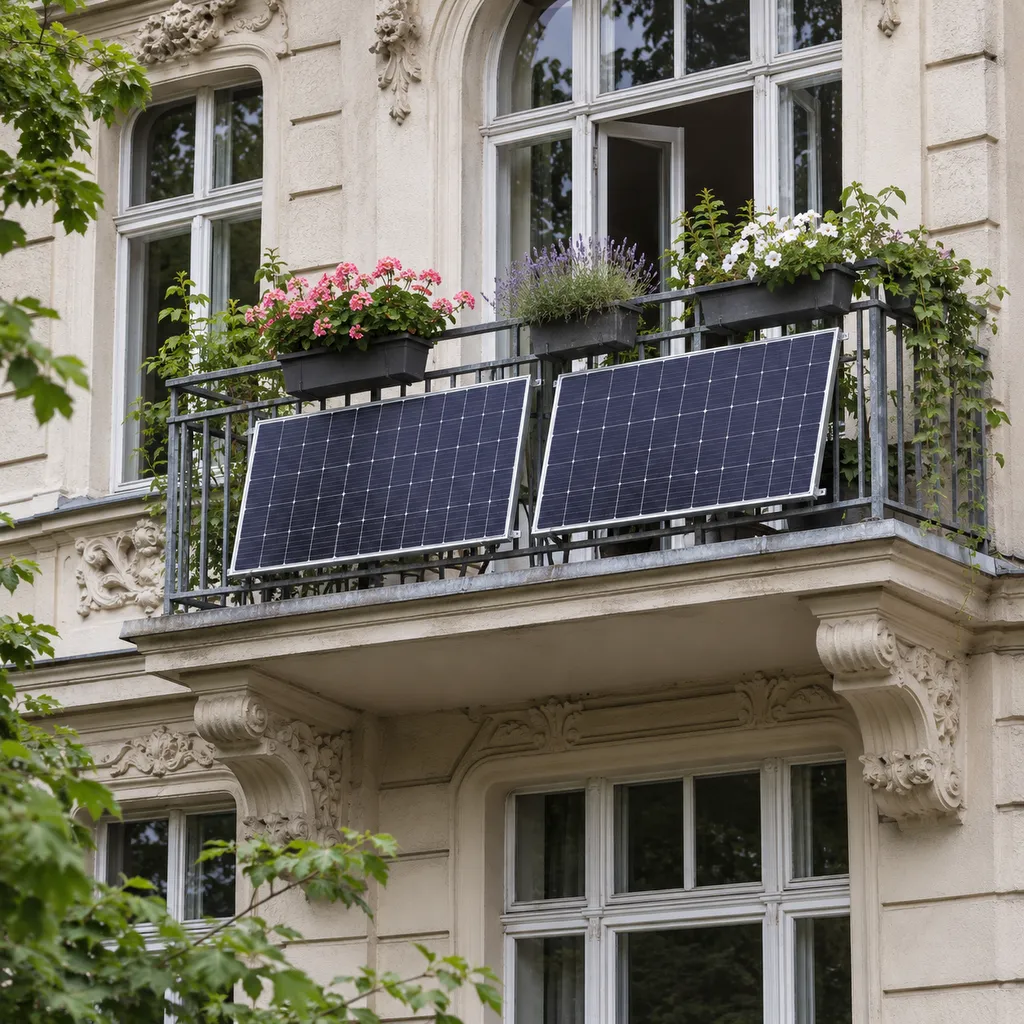
Power limits since Solarpaket I
Germany’s renewable energy act (EEG, § 3 Nr. 43) defines a Steckersolargerät — a plug-in solar device — with two limits: no more than 2,000 W of panels and 800 VA of inverter output in total 2. These special rules apply to devices commissioned from 16 May 2024 2.
Both limits are added up across all devices behind the same metering point. What counts is the highest output the inverter can be set to, even if software caps it lower 2.
The old 600 VA limit no longer exists 1.
Registering in the Marktstammdatenregister
The only formality is registering the device in the Marktstammdatenregister (MaStR), the installation register run by the Bundesnetzagentur, the federal regulator. You have one month from commissioning 12.
You no longer need to notify the Netzbetreiber (your local grid operator): the Bundesnetzagentur passes the information on automatically 38. Only if you want to be paid for the electricity you feed into the grid do you also have to register with the Netzbetreiber 1.
Since 1 April 2024, on top of your personal details, the register asks for “only five details” about the device instead of around 20 8.
Electricity meter
The Netzbetreiber or the Messstellenbetreiber (the company that runs your meter) has to fit a bidirectional meter (Zweirichtungszähler) or a smart metering system 2.
You can connect the device before the swap; in the meantime, readings from the old meter are treated as correct. The swap has to happen without undue delay (“unverzüglich”) and without you having to order it. According to the Bundesnetzagentur, this grace period should last weeks, a few months at most 2.
An old Ferraris meter that runs backwards is allowed until then 3. You cannot be charged for the meter swap 314.
Plug: Schuko or Wieland
The product standard DIN VDE V 0126-95 was published on 14 November 2025 and has applied since 1 December 2025 45. It is a Vornorm: a technical standard, not a law.
An ordinary Schuko plug complies if the device has no more than 960 Wp of panels and 800 VA of inverter output 14. Basic protection must come from a modified plug with a protective cover, an internal disconnect switch or galvanic isolation in the inverter 14. Never connect several devices through a power strip 1.
Between 960 Wp and 2,000 Wp you need a special energy socket, for example to DIN VDE V 0628-1, usually called “Wieland” 14. That socket must be fitted by an electrician 3. The VDE recommends having an electrician check the circuit; the fuse may need to be reduced 1.
The inverter needs a unit certificate (Einheitenzertifikat) showing it meets the grid connection standard VDE-AR-N 4105 1. The current version is VDE-AR-N 4105:2026-03, in use since 1 March 2026 115.
Renters and flat owners
Since 17 October 2024, generating electricity with a Steckersolargerät has been a “privileged measure” under § 554 BGB (the Civil Code’s tenancy rules) and § 20 WEG (the law on owner-occupied flats), alongside EV charging, accessibility, burglary protection and fibre broadband 673.
As a tenant, you can require your landlord to allow the necessary alteration. The landlord can only refuse if it would be unreasonable for them (“nicht zumutbar”), even taking your interest into account 63. Any clause in your contract to your disadvantage is void (§ 554 Abs. 2), and the landlord can ask for an additional security deposit 6. It is a right to obtain permission, not an exemption: you still have to ask.
As a flat owner, you can require the owners’ association to approve an “angemessen” (reasonable) installation; the association decides by majority how it is done. You cannot demand it if it fundamentally changes the building or unfairly disadvantages another owner (§ 20 Abs. 4 WEG) 7.
If you rent a flat in such a building, you ask your landlord, who can in turn require the association’s approval 17.
Kits with a batteryUnder review
The battery counts as a separate unit: you also have to register it in the MaStR within one month, and the EEG has no exceptions for plug-in solar batteries 914.
According to the official VDE form (Annex F of VDE-AR-N 4105:2026-03), form F.1.2 is the simplified procedure for set-ups of up to 800 VA in total. It goes to the Netzbetreiber, in addition to the MaStR entry, if you want feed-in payment, if you have panels with a battery, or if you only have a battery 18.
This point is not fully settled: grid operators do not all handle it the same way, and one secondary source we could not verify says some require the full procedure with an electrician 15. Check with your Netzbetreiber before connecting.
DIN VDE V 0126-95 does not cover devices with a built-in battery; a DKE committee is drafting a separate standard 45.
VAT, subsidies and insurance
Panels, essential components and batteries are sold at 0 % VAT (§ 12 Abs. 3 Nr. 1 UStG) if installed on or near a home and the gross output in the MaStR is no more than 30 kWp 19. This includes Steckersolargeräte 3.
In 2026 there is no federal grant specifically for these kits, and many regional and municipal budgets have run out 2021. Local schemes change constantly: always check the official source.
Two examples with an official source. Munich pays €0.40/Wp up to 800 Wp per home (at most €320 and 50 % of the cost, or 95 % with a München-Pass), and you must apply before buying 24. Mecklenburg-Western Pomerania pays €500 to tenants whose main home is in the state, applied for by post once the device is installed 2223; the quota for owners has been used up since 2023 23, and we found no official 2026 page confirming how much budget is left.
Insurance is optional. The device can often be added to your buildings, home contents or liability insurance; tell your insurer 3.
Unconfirmed pointsUnder review
MaStR details: the Bundesnetzagentur mentions five 8, but pv magazine lists six: location, display name of the unit, commissioning date, total panel output, inverter output and meter number 9. We found no official list, so it is unclear whether the meter number is mandatory.
Devices installed before DIN VDE V 0126-95: secondary sources say the standard is not retroactive and existing devices need no changes 16, but no official VDE or DKE source confirms this.
Form F.1.2: according to secondary sources, a private person can fill it in without an electrician’s signature 15.
Other local schemes: aggregator sites in October 2026 list Konstanz, Pforzheim, Göttingen (since 1 June 2026) and Darmstadt as open, and Cologne (since 28 September 2026), Stuttgart, Freiburg, Bonn, Kassel, Heidelberg, Böblingen and Saxony as used up or closed 2021. We have not checked these on the official websites.
Information, not legal advice
This page summarises the rules as of 6 November 2026, based on the sources cited. It is general information, not legal advice. Rules and subsidies change: before you decide, check the official source and, if you are unsure about your case, ask a professional, your Netzbetreiber or the Verbraucherzentrale (Germany’s consumer advice centres).
What is about to change
- EEG 2027: the government bill (Drucksache 21/7867, 29 July 2026) had its first reading on 24 September 2026. Press reports expect the second and third readings in mid-November 2026, with entry into force planned for 1 January 2027 1025.
- According to the draft and analyses, EEG 2027 would keep the 2 kW and 800 VA limits, pay nothing for feed-in and make clear that you can have more than one device 111213.
- The definition would include a battery connected “hinter demselben Wechselrichter” (behind the same inverter); an AC battery with its own inverter would fall outside it, according to industry readings 1112.
- There is political pushback: the SPD wants changes and a Bundesrat committee proposes separate rules for small installations. The final text may change 25.
- VDE-AR-N 4105:2026-03: according to secondary sources, a general transition period runs until early March 2027 15. The DKE is drafting a product standard for devices with batteries 45.
Before you buy
- Choose a device with an inverter of up to 800 VA, panels of up to 2,000 Wp and a VDE-AR-N 4105 certificate. To use Schuko: panels of up to 960 Wp and a device that meets DIN VDE V 0126-95 14.
- If you rent, ask your landlord for written permission before fitting it; if you own a flat, ask the owners’ association for approval 67.
- Check your city or state subsidies before buying: some, like Munich’s, require you to apply first 24. Make sure the invoice shows 0 % VAT 19.
- Register the device (and any battery, as a separate unit) in the MaStR within one month of commissioning 129.
- Do not use power strips. If your wiring is old or you want a Wieland plug, call an electrician 13.
- Tell your insurer about the device 3.
Sources
- VDE FNN, „Steckerfertige PV-Anlagen: Anschluss & Anmeldung“ (03.03.2026)
- Bundesnetzagentur, „Solaranlagen und andere EE-Anlagen“ – FAQ zu Steckersolargerätenofficial
- Verbraucherzentrale, „FAQ zu Steckersolar-Geräten“ (06.03.2026)
- pv magazine, „Schuko-Stecker meistens ausreichend: VDE veröffentlicht Produktnorm für Stecker-Solar-Geräte“ (14.11.2025)
- BSW-Solar, „DIN/VDE: Schuko-Stecker sind solar-sicher“ (12.11.2025)
- § 554 BGB (gesetze-im-internet.de)official
- § 20 WEG (gesetze-im-internet.de)official
- Bundesnetzagentur, Pressemitteilung „Bundesnetzagentur vereinfacht die Registrierung von Balkonkraftwerken“ (28.03.2024)official
- pv magazine, „Diese Angaben braucht es zur Anmeldung von Photovoltaik-Balkonanlagen im Marktstammdatenregister“ (03.04.2024)
- BMWE, Gesetzentwurf der Bundesregierung EEG/Stromsektor (29.07.2026)official
- BMWE, Referentenentwurf EEG 2027 (20.04.2026)official
- balkon.solar e.V., „Entwurf des neuen EEG 2027 für Steckerspeicher verbesserungsfähig“ (03.03.2026)
- t-online, „EEG-Reform 2027: Das ändert sich für Balkonkraftwerke“ (2026)
- Umweltbundesamt, „Steckersolargeräte (Balkonkraftwerke)“official
- Sonnco, „Neue VDE-Norm 2026: Was sich bei der Anmeldung von Balkonkraftwerken und Speichern ändert“ (2026)
- balkonkraftwerk-abc.de, „DIN VDE V 0126-95 einfach erklärt“ (2026)
- Balkon-kraft-werke.de, „§ 554 BGB: Balkonkraftwerk als Mieter & in der WEG“ (2026)
- VDE, „Anhang F – Formulare zur VDE-AR-N 4105“ (2026)
- § 12 UStG (gesetze-im-internet.de)official
- bleibwarm.de, „Balkonkraftwerk Förderung 2026“ (14.10.2026)
- solaranlage-tipps.de, „Balkonkraftwerk-Förderung 2026“ (Oktober 2026)
- LFI M-V, Antragsformular „Antrag/VN steckerfertige PV-Anlagen“ (18.02.2025)official
- energie-fachberater.de, „Mecklenburg-Vorpommern fördert Balkonkraftwerke noch für Mieter“ (01.01.2026)
- Landeshauptstadt München, Förderrichtlinie FKG (2026)official
- pv magazine, „Erste Lesung von EEG-Novelle und Netzpaket auf der Tagesordnung des Bundestags“ (14.09.2026)