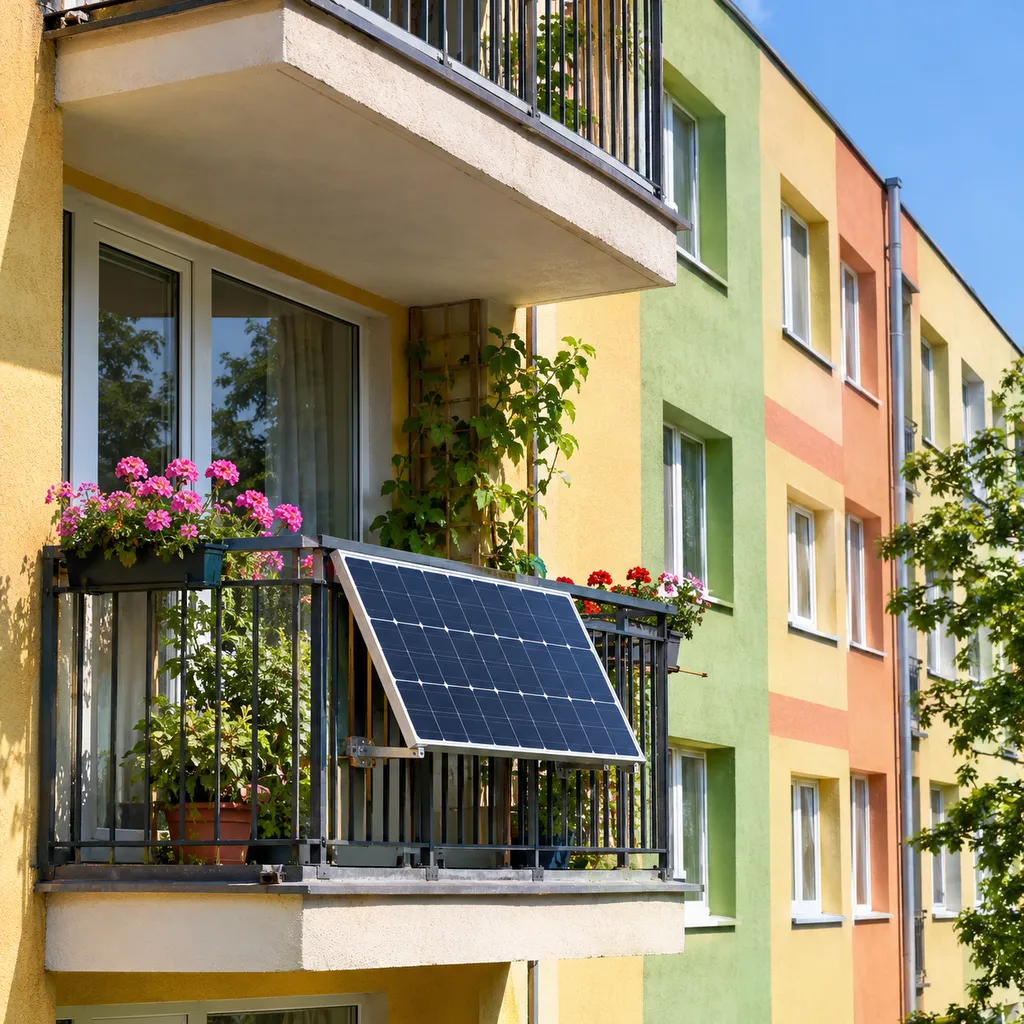
Legal status: a mikroinstalacja like any other
Poland has no separate category for balcony kits. The renewable energy act (ustawa o OZE) defines a mikroinstalacja as a renewable installation of up to 50 kW connected to a grid below 110 kV, with no lower power band 5. An 800 W kit plugged into a socket is therefore legally a mikroinstalacja.
There is no simplified regime up to 800 W, either in force or in the pipeline. In January 2025 the Ministry of Climate and Environment (MKiŚ) viewed a dedicated notification procedure up to 800 W ‘positively’, but said it needed detailed analysis and dialogue with the grid operators 2. On 16 September 2026 it stated that it is not currently working on any additional simplifications for balcony installations 3.
Notifying your grid operator (OSD)
The OSD (operator systemu dystrybucyjnego) is your distribution network operator: PGE, Tauron, Energa, Enea or Stoen. Article 7(8d4) of the Energy Law (Prawo energetyczne) lets you connect a mikroinstalacja with a simple zgłoszenie (notification), without connection conditions, if you are already on the grid and the installed power does not exceed your contracted power 6.
Tauron Dystrybucja spells it out: the zgłoszenie must be filed no later than 30 days before the planned start-up, the installed power must not exceed the connection capacity of your home, and the OSD fits or configures a bidirectional meter at its own cost within 30 days 7.
Tauron’s form includes a declaration by the installer, who must hold an OZE certificate, an electrical qualification certificate or uprawnienia budowlane (building licences) 7. Other sources say a kit under 0.8 kW can be fitted without a certified installer, and practice varies between operators and branches 12. Ask your OSD which installer declaration it accepts for a plug-in kit.
Inverter certificate and plug
According to the MKiŚ, modules under 0.8 kW fall outside the EU grid code NC RfG (Regulation (EU) 2016/631) 3. In practice, though, the OSD asks for the inverter to be on the PTPiREE list, or for technical documentation and an NC RfG conformity certificate. Since 1 May 2022 only final certificates (certyfikaty docelowe) from an accredited body are accepted 78.
The PTPiREE list (wykaz certyfikatów) is compiled by the member OSDs and PSE 89. Under PTPiREE’s notice of 5 October 2026, certificates issued under WiPWC 1.2 stop being valid for connection after 31 December 2026: for type A modules (mikroinstalacje included) notified from 1 January 2027, such equipment ‘will not be accepted’. Check the acceptance date in version 1.3 of the list 910. The notice does not say whether this covers modules under 0.8 kW.
We found no Polish standard and no official position from any OSD on the plug. Europe’s reference product standard is Germany’s DIN VDE V 0126-95, which allows a Schuko plug under conditions; there is no record of Poland adopting it 23. The draft building regulations (WT) do not mention a plug either 14.
Polish sockets (type E, with an earth pin) and the TN-C wiring of older blocks of flats are a real issue, as the Silesia case shows 12. With no Polish standard, the most cautious option is a dedicated socket (Wieland-type or similar) fitted by an electrician.
Housing community and planning rules
According to settled case law, the outside of a balcony is common property (nieruchomość wspólna). You need prior consent from the spółdzielnia (housing cooperative) or the wspólnota mieszkaniowa (homeowners’ association). Without it you can be ordered to take the kit down, ultimately by a final court judgment 114. The MKiŚ itself says the main problem is neighbourly and organisational issues and each community’s own rules, not the law 3.
A real case (Silesia, March 2026): a resident installed an 800 W kit with a PTPiREE-listed microinverter and then asked the cooperative to accept it. It refused because the building has TN-C wiring (no protective conductor) and required him to modernise the installation, with a design and technical supervision at his own expense. The OSD had raised no objection. The dispute was still open in mid-March 2026 123.
Under the Construction Law (Prawo budowlane, art. 29(4)(3)(c)), PV installations up to 150 kW need neither a permit nor a building notification (previously 50 kW; the change has applied since 1 October 2023) 243. A balcony kit needs no planning procedure. The local plan (MPZP), heritage protection rules and any uchwały krajobrazowe (landscape resolutions) may still apply; we have not checked how they affect balconies 24.
If you rentUnder review
A tenant (najemca) needs written consent from the owner and also from the management or community 13. Unlike in Germany, tenants in Poland have no legal right to install a kit.
We have only found this in secondary sources and have not checked the Civil Code (Kodeks cywilny), so treat it as unconfirmed.
Surplus, net-billing and not notifying
Once the zgłoszenie is done, you become a prosument energii odnawialnej (renewable energy prosumer). Prosumers who joined from 1 April 2022 settle under net-billing: exported energy is valued at the market price (RCE) and credited to a prosumer deposit 5.
For an 800 W kit, an Instrat analysis published by Gramwzielone (20 February 2026) puts the surplus at about 35 kWh a year. Almost all the saving comes from self-consumption: roughly 574–757 zł a year 4.
We found no specific administrative penalty for failing to notify a mikroinstalacja. The figures circulating on blogs (1,000 zł, 5,000 zł) cite no legal basis and we consider them unreliable 25. Article 57 of the Energy Law (pobór nielegalny) concerns illegal consumption, not export 625. The real risks: without a zgłoszenie you get no prosument status or settlement, so whatever you export is given away to the grid; you breach the connection procedure; and you risk a dispute with your community 41125.
Tauron’s ZM form lets you declare an installation that does not export to the grid if it has anti-export protection. Even then, it is still a notification to the OSD 26.
Subsidies and VAT
There is no national grant for a balcony kit on its own. The 6th round of Mój Prąd is closed, and the NFOŚiGW (the national environmental fund) says ‘Mój Prąd 7.0’ will not launch in its current format, and warns of scams 16. The scheme has always required at least 2 kWp, and in January 2025 the MKiŚ refused to open it to balcony kits 2. In September 2026 the ministry said no separate support mechanisms are planned for balcony PV 3.
The follow-on scheme Przydomowe Magazyny Energii (part 2, call from 20 October 2026 to 1 October 2027, according to press reports) funds energy storage, not PV on its own 17.
The ulga termomodernizacyjna (a thermal-modernisation income tax relief, PIT) is only for owners of a single-family house (budynek mieszkalny jednorodzinny), not flats in blocks; in a house it can cover a plug-in kit you fit yourself 18. Warsaw’s Warszawskie Ekodotacje pay 1,500 zł/kW, but it is unclear whether balcony kits qualify or whether a licensed electrician is required: ask the city on 19115 127.
If you buy the kit alone, without installation, VAT is 23%. The 8% rate only applies to a supply-and-installation service in a residential building (up to 300 m² for houses and 150 m² for flats) 19.
What is still unconfirmedUnder review
Some blogs say no zgłoszenie is needed up to 800 W. No official source backs this, and Tauron and the MKiŚ always refer to a zgłoszenie 37. Until a rule says otherwise, assume you must notify.
In Poland, 800 W is the threshold above which the NC RfG treats a generating module as ‘significant’. According to Gramwzielone, Poland measures it on the DC power of the panels rather than the inverter’s AC output, as Germany does, based on position 44/2016 of the president of the regulator URE, which we could not consult 1.
Some texts say an old meter may count exported energy as consumption, or that the OSD can disconnect you if you have not notified. We have found no official technical or legal basis for either.
The 800 W threshold attributed to the EU Recommendation comes from secondary sources; we could not read the full paragraph of the official text 15.
Information, not legal advice
This page summarises public sources as of 6 November 2026. It is not legal, tax or technical advice. Rules, OSD practice and schemes change: check with your OSD, your housing community and, if needed, a lawyer or a qualified electrician before you buy or install.
balconsun.com is an independent information site: we sell no products and are not tied to any brand.
What is about to change
- From 1 January 2027: inverters with WiPWC 1.2 certificates are not accepted for new zgłoszenia; check PTPiREE list v1.3 9.
- Draft building regulations (WT, RCL project 12412604, version of 6 August 2026): would regulate balcony PV in blocks of flats for the first time (inverters ≤2 kW, panels ≤2.3 kW, ≤60 V DC, no DC cables inside the home, wind-resistant mounting, maximum height 25 m, anti-islanding protection). Globenergia warns it does ‘not mean plug and play’ 1420.
- As of 21 October 2026 the draft WT had not been signed or published in the Dziennik Ustaw; the ministry (MRiT) set an 18-month transitional period under the old rules from 20 September 2026 2122.
- Recommendation (EU) 2026/1007 (30 April 2026, OJ of 8 May 2026): asks for administrative requirements on balcony PV and plug-in batteries to be removed, but it is not binding, and the MKiŚ is not working on changes (16 September 2026) 153.
- DC or AC limit: the debate remains open, with no action announced 12.
Before you buy
- Check the inverter is on PTPiREE list v1.3: from 1 January 2027 WiPWC 1.2 certificates no longer count 9.
- Get written consent from your spółdzielnia or wspólnota (and from the owner if you rent) before fitting anything 1113.
- File the zgłoszenie with your OSD at least 30 days before connecting, and ask which installer declaration it accepts for a plug-in kit 7.
- Do not export until the bidirectional meter is in place: the OSD replaces it free of charge within 30 days 7.
- In older blocks with TN-C wiring, have an electrician inspect the installation and consider a dedicated socket (Wieland-type or similar) 12.
- Budget with 23% VAT and no national grant: the saving comes mostly from self-consumption 341619.
Sources
- Gramwzielone.pl, „Fotowoltaika na balkonie – co trzeba wiedzieć?” (wywiad z R. Pabierowskim, OneStep.Solar), 10.01.2025
- Gramwzielone.pl, „Fotowoltaika na balkonie. Tak dla uproszczenia procedur, nie dla dotacji z Mojego Prądu”, 17.01.2025
- Gramwzielone.pl, „Fotowoltaika balkonowa bez ulg i dotacji? Mamy odpowiedź ministerstwa” (odpowiedź MKiŚ), 16.09.2026
- Gramwzielone.pl, „Balkonowi prosumenci mogą zaoszczędzić ponad 700 zł…” (analiza Instrat), 20.02.2026
- ISAP, Ustawa z dnia 20 lutego 2015 r. o odnawialnych źródłach energii (Dz.U. 2015 poz. 478 z późn. zm.)official
- ISAP, Ustawa z dnia 10 kwietnia 1997 r. Prawo energetyczne (art. 7 ust. 8d4, art. 57)official
- TAURON Dystrybucja, „Mikroinstalacja”
- PGE Dystrybucja, „Komunikat dot. wymogów dla falowników/inwerterów stosowanych w Modułach Wytwarzania Energii”
- PTPiREE, „Komunikat dotyczący wykazu urządzeń zgodnych z wymaganiami NC RfG”, 5.10.2026
- Stoen Operator, komunikat dotyczący wykazu urządzeń zgodnych z wymaganiami NC RfG publikowanego przez PTPiREE z dnia 5 października 2026 r., 15.10.2026
- Globenergia, „Nakaz demontażu fotowoltaiki i pozew – czy to normalna procedura?” (J. Plebański, Rödl), 19.04.2024
- Portal Samorządowy, „Zamontował fotowoltaikę na balkonie. Spółdzielnia każe mu wymienić elektrykę w całym bloku”, marzec 2026
- Wprost Biznes, „Fotowoltaika na balkonie wymaga zgody. Bez niej spółdzielnia może nakazać demontaż”, 2026
- Globenergia, „Fotowoltaika balkonowa w nowych przepisach. Ułatwienie czy kolejna bariera?”, 9.08.2026
- Commission Recommendation (EU) 2026/1007 of 30 April 2026 (OJ L, 8.5.2026)official
- NFOŚiGW, mojprad.gov.plofficial
- Globenergia, „Druga szansa na dotację do magazynu energii i PV. NFOŚiGW wznawia nabór…”, 2026
- Gramwzielone.pl, „Ulga termomodernizacyjna dyskryminuje mieszkańców bloków”, 2025
- Solidna Księgowa, „Fotowoltaika a VAT – kiedy wystawić fakturę z 8%, a kiedy 23%”
- e-magazyny.pl, „Magazyn energii w bloku i nowe zasady fotowoltaiki. Wielkie zmiany od 20 września 2026 r.”, 2026
- Murator, „Nowe Warunki techniczne spóźnione, ratunek w prowizorce – stare przepisy jeszcze przez 18 miesięcy”, wrzesień 2026
- domy.energetycznyprojekt.pl, „Warunki techniczne 2026: nowe WT nie weszły”, stan na 21.10.2026
- Z.I.P.E., „Fotowoltaika balkonowa zyskuje ramy prawne – pierwsza norma instalacyjna…”, 15.12.2025
- WP Finanse, „Fotowoltaika bez pozwolenia. Oto kiedy nie musimy zgłaszać prac”, 2026
- elektrosiec.pl, „Kara za niezgłoszenie instalacji fotowoltaicznej – kompleksowy przewodnik po obowiązkach i konsekwencjach”
- TAURON, formularz „ZM – Zgłoszenie mikroinstalacji”
- Grupa Płon, „Warszawskie Ekodotacje 2026/2027”, 2026