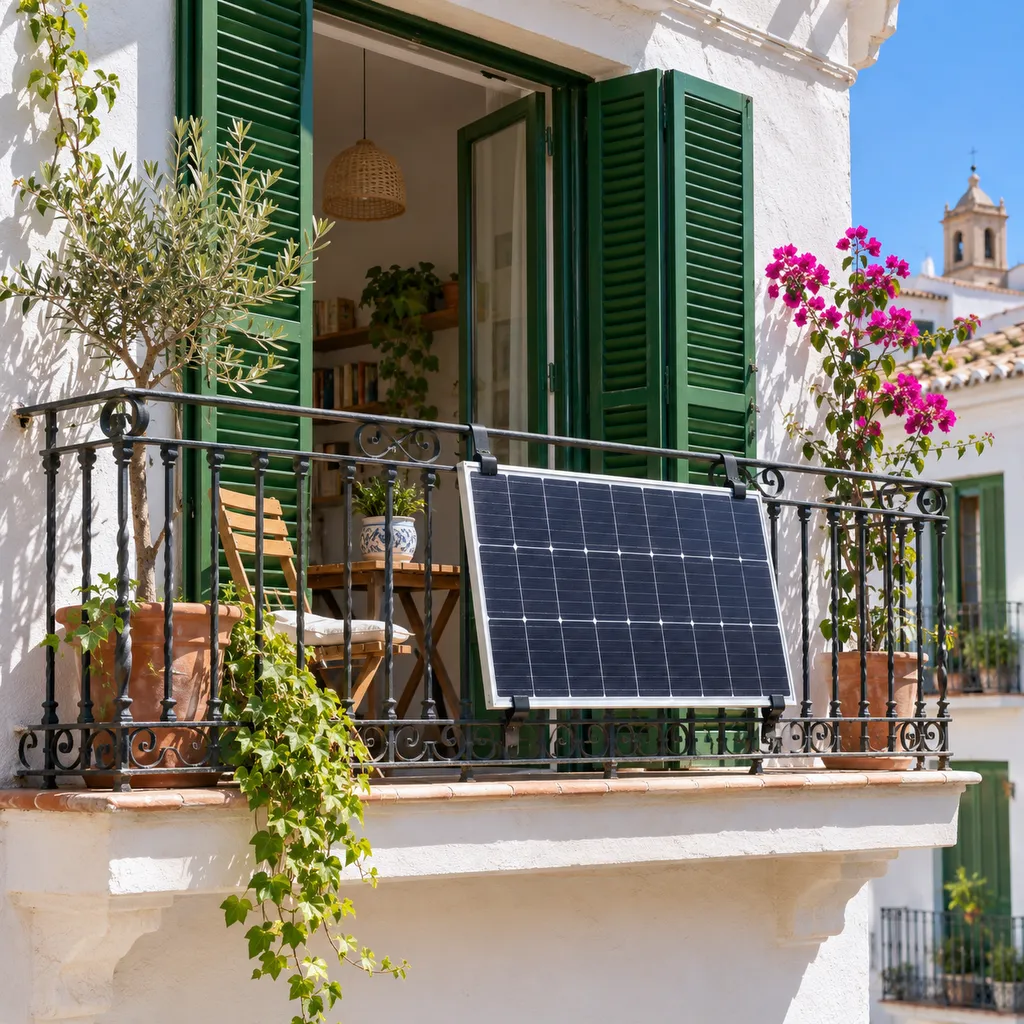
Is it legal? The 800 VA limit
Installing a balcony solar kit is legal 2. But Spain has no specific regime for these kits: Royal Decree 244/2019 on self-consumption applies, together with ITC-BT-40 of the Low Voltage Electrotechnical Regulation (REBT), as amended by that same decree 123. Royal Decree-law 7/2026 amended RD 244/2019, but it did not create any regime for balcony kits 1213.
800 VA is not an administrative exemption. It is the threshold above which the generator must run on its own dedicated circuit, from a consumer unit with residual current protection. The same applies to any installation that exports surplus, whatever its power 1.
According to IDAE, the national energy agency, up to 800 VA with no export and no dedicated circuit you don’t need an installer and there is no electrical installation certificate (CIE). Above 800 VA, with or without export, you need a dedicated circuit, an installer and the certificate 23.
We found no Spanish rule setting a 1,500 W threshold for kits. The thresholds that matter are 800 VA (ITC-BT-40), 15 kW (exemption from grid access and connection permits for exporting installations on urban land) and 100 kW (automatic registration and simplified net billing) 1.
Installer, certificate and registration
An installation with no export is exempt from grid access and connection permits 1. If your kit doesn’t run on its own circuit and the home wiring doesn’t need changing, the manufacturer, importer or seller must give you the declaration of conformity directly 1.
If you connect a kit of up to 800 VA with no export to a dedicated circuit, you need an installer and a CIE, and registration is compulsory. IDAE puts it plainly: “Registration is not voluntary; if there is an independent circuit it is compulsory” 2.
For low-voltage installations under 100 kW, the regional government registers the installation automatically from the REBT paperwork and passes it on to the national register (RADNE). The distribution company has electronic access to the register, so with no export you don’t have to notify it directly 1. In Catalonia, for example, the Generalitat adds the installation to the Catalan self-consumption register (RAC) once it has been legalised 11.
Zero-export device, inverter and safety
A zero-export device (“vertido cero”) is compulsory for all self-consumption without surplus, and it can be built into the kit 2. It must meet Annex I of ITC-BT-40 and the tests in standard UNE 217001:2020 11718.
The inverter is tested to UNE 217002:2020, which covers DC injection, overvoltage and islanding detection. Distribution companies also ask for UNE-EN 62116 (anti-islanding) 1718.
If a generator in a home is not on a dedicated circuit or an isolating transformer, its earth leakage current must be 10 mA at most. A dedicated circuit, where there is one, needs a type A residual current device 1.
Surplus: what happens to the energy you don’t use
With no export, the only legal case without an installer, the kit must not feed power into the grid. The zero-export device has to keep the connection point in net consumption, and the generator must shut down within 2 seconds if it loses contact with the controller 1.
In legal terms, a kit without a zero-export device counts as self-consumption with surplus and no net billing. That requires a dedicated circuit, an installer, a CIE and registration, whatever the power. Exporting through a socket with no dedicated circuit or CIE does not comply with the rules 1.
Simplified net billing requires a renewable installation with surplus of up to 100 kW, a compensation contract, registration and a CIE. It is a monthly financial credit and cannot exceed the value of the energy you consume 1. A plug-in kit without a CIE can’t use it: you are not paid for the energy it exports.
Every form of self-consumption requires a bidirectional meter at the connection point 1.
Homeowners’ associations
Since 22 March 2026, article 17.1 of the Horizontal Property Act (LPH), as worded by Royal Decree-law 7/2026, lets an association approve “common or private systems for using renewable energy” with the votes of 1/3 of the owners holding 1/3 of the shares. Any owner can ask for it, and the association can’t charge the cost to those who didn’t vote in favour 56.
Parliament ratified RDL 7/2026 on 26 March 2026 1314. An earlier reform, in RDL 7/2025, lapsed because Parliament did not ratify it (resolution of 22 July 2025) 5.
Under article 7.1 of the LPH, you can alter your private property as long as you don’t affect safety, the structure or the exterior appearance or condition, and you must tell the association’s representative beforehand 5. Railings and façades are usually common elements or part of the exterior appearance. Also check the bylaws and house rules: they may set their own restrictions.
Renting and the town hall
Under article 23 of the Urban Leases Act (LAU), a tenant may not carry out works that change the layout of the home or its fittings without the landlord’s written consent. If you do, the landlord can make you restore it or end the lease 7.
Local bylaws may require a minor works licence or notice if there are permanent fixings or the façade changes, especially in listed buildings or historic centres. IDAE reminds town halls that self-consumption under 10 kW is exempt from certain authorisations 20. Ask your town hall.
Grants and tax
RDL 7/2026 created a new income tax (IRPF) deduction (additional provision 62 of the IRPF Act): 10% of what you pay in 2026 for renewable self-consumption systems in a property you own, or 20% if installed in homes in mainly residential buildings. The maximum base is €5,000 a year and can include storage 813.
The installation must be carried out and completed in 2026, and paid for in 2026 too, never in cash. You need the permits, in particular the electrical installation certificate (CIE), and must comply with RD 244/2019. It can’t be combined with the additional provision 50 deduction for the same installation, and any public grant reduces the base. The tax agency says nothing about tenants; the wording (“a property they own”) points to owners 8.
The energy efficiency deduction in additional provision 50 (20, 40 or 60%) has been extended, but it requires consumption savings proven with an energy certificate 9. Town halls may offer up to 50% off property tax (IBI) and up to 95% off the construction tax (ICIO), if their bylaws provide for it and the installation is “approved” 10.
Next Generation grants under RD 477/2021 are no longer available: applications closed on 31 December 2023 and funds have run out in most regions (Castilla-La Mancha, for example, declared them exhausted in June 2026). Kits without a CIE were excluded anyway 32122.
What is not confirmedUnder review
Registering kits without a CIE. IDAE’s professional guide says all installations with no export go on the register, but automatic registration starts from the CIE, and a kit of up to 800 VA with no dedicated circuit doesn’t have one. There is no documented way for you to report it yourself, and commercial websites contradict each other without citing any rule 124. Older versions of the guide (2019–2020) required an installer even without a dedicated circuit; the 2023 FAQ says no, and the more recent reading prevails 24.
Schuko plug. We found no Spanish rule that expressly allows or bans plugging a kit into a household Schuko socket: ITC-BT-40 talks about the circuit, not the connector 1. Some commercial sources say Schuko is accepted up to 800 VA, but they cite no rule 2728. Spain has no equivalent of the German standard DIN VDE V 0126-95.
NTS certificate. Order TED/749/2020 requires it for type A generating modules, from 0.8 kW to 100 kW 19. This implies a kit under 800 W falls outside it, but no text says so expressly.
Other points. A panel fixed to the railing or façade probably needs the association’s approval, but no rule or court ruling we checked settles it. It is unclear whether a removable kit with no building work counts as “works” under the LAU. It is not known whether current meters record the energy exported by an undeclared kit. And a kit without a CIE probably does not qualify for the 2026 income tax deduction.
This is information, not legal advice
This page summarises the rules from public sources checked on 6 November 2026. It is general information, not legal or technical advice, and the rules change.
Before installing, check with your town hall, your regional government or a licensed installer and, if you have questions about the meter or registration, with your distribution company. The official texts take precedence over this summary.
What is about to change
- New self-consumption royal decree: put out for public consultation in October 2025 and expected “this summer” as of April 2026, but not published in the BOE as of 6 November 2026 1516.
- New REBT: the draft was notified in 2025, with a new ITC-BT-53 for direct current and solar PV. It has not been published in the BOE and there is no sign it covers plug-in kits 26.
- RfG 2.0 (revision of EU Regulation 2016/631): draft published on 8 July 2026, consultation closed on 25 August, adoption planned for Q4 2026 and general requirements from around the end of 2028. It is not known whether it changes the 0.8 kW threshold 25.
- Recommendation (EU) 2026/1007 of 30 April 2026: not binding. According to secondary sources, it asks countries to remove administrative barriers for kits of up to 800 W; we could not confirm this in the official text 2324.
- There is no official announcement of a Spanish “notification only” regime for 800 W kits like those in France, Belgium or Germany.
Before you buy
- Choose a kit with up to 800 VA inverter output and a zero-export device that meets UNE 217001. A plain microinverter that exports to the grid is not legal plugged into a socket 117.
- Ask the seller for the conformity paperwork: CE declaration, anti-islanding (UNE 217002 / IEC 62116), zero-export and leakage of 10 mA at most. The seller must provide it 1.
- Plug it into an earthed socket in good condition, on a circuit that isn’t already near its load limit. If you want a dedicated circuit or go above 800 VA, hire a licensed installer, who will issue the CIE.
- If you own the flat and the panel is fixed to the railing or façade, or visible from outside, take it to the owners’ meeting: 1/3 of owners and 1/3 of shares is enough. Check the bylaws too 5.
- If you rent, get the landlord’s written consent and, if anything is fixed to the railing, the association’s too. Keep everything removable, with no drilling 7.
- If there are permanent fixings or the building is listed, ask the town hall whether you need a minor works notice or licence.
Sources
- Real Decreto 244/2019, de 5 de abril (texto consolidado, última actualización publicada el 21/03/2026), arts. 4, 7, 10, 14, 19, 20 y DF 2.ª (ITC-BT-40)official
- IDAE, Oficina de Autoconsumo, «99 preguntas frecuentes» v2 (31/03/2023), pregunta 39official
- IDAE, preguntas frecuentes de los programas del RD 477/2021 (09/02/2023)official
- IDAE, Guía Profesional de Tramitación del Autoconsumo v6 (09/07/2024)official
- Ley 49/1960, de 21 de julio, sobre propiedad horizontal (texto consolidado, actualización del 03/10/2026)official
- Real Decreto-ley 7/2026, de 20 de marzo (BOE-A-2026-6544, BOE del 21/03/2026)official
- Ley 29/1994, de 24 de noviembre, de Arrendamientos Urbanos (texto consolidado, actualización del 07/10/2026), art. 23official
- Agencia Tributaria, «Principales novedades tributarias introducidas por el Real Decreto-ley 7/2026»official
- Agencia Tributaria, «Medidas en materia de tributación» (23/03/2026)official
- Real Decreto Legislativo 2/2004, texto refundido de la Ley Reguladora de las Haciendas Locales, arts. 74.5 y 103.2.bofficial
- Generalitat de Catalunya, «Instal·lacions inscrites al Registre d'autoconsum de Catalunya (RAC)»official
- PwC Periscopio Fiscal y Legal, «Medidas regulatorias energéticas (I) del Real Decreto-ley 7/2026» (03/2026)
- Fotovol, «Real Decreto-ley 7/2026: qué cambia en el autoconsumo» (2026)
- Oficina de Transición Energética del Cabildo de Tenerife, «Convalidado el Real Decreto-ley 7/2026» (03/2026)official
- pv magazine España, «A audiencia pública el nuevo RD de autoconsumo…» (09/10/2025)
- Energías Renovables, «El nuevo real decreto de autoconsumo podría presentarse este verano» (14/04/2026)
- UNE, comité CTN 217 (UNE 217001:2020 y UNE 217002:2020)
- UFD (Naturgy), «Listado de mecanismos antivertido e inversores verificados» (03/2025)
- Red Eléctrica, preguntas frecuentes sobre la puesta en servicio de nuevas instalaciones
- IDAE, «Guía de orientaciones a los municipios para el autoconsumo» (20/10/2023)official
- Junta de Comunidades de Castilla-La Mancha, resolución de agotamiento del crédito de las ayudas de autoconsumo (06/2026)official
- Gobierno de Aragón, ayudas para instalaciones de autoconsumo en el sector residencial (RD 477/2021)official
- Commission Recommendation (EU) 2026/1007 of 30 April 2026official
- greenMe, «Balcony solar panels: EU to scrap permits for under 800W» (2026)
- Plugchoice, «RfG 2.0 consultation closed, 117 responses, adoption planned Q4 2026» (2026)
- COGITI, webinar «Novedades REBT 2026» (22/04/2026)
- Tornasol Energy, «¿Es legal una batería o kit solar enchufable? Normativa 2026»
- Solarbalcon.es, «Kit solar plug and play España 2026: 800 W, mito alemán»