Since when it’s legal, and which law did it
Plug-in solar has been legal in Great Britain (England, Wales and Scotland) since 27 August 2026 17. The law behind it is SI 2026/848, which amends the Plugs and Sockets etc. (Safety) Regulations 1994 and the Electricity Safety, Quality and Continuity Regulations 2002 (ESQCR). It was made on 16 July 2026 and laid before Parliament on 17 July 1.
The steps: the government announced the plan on 24 March 2026 6; DESNZ consulted from 16 to 30 June and received 466 responses 23; it published its response and the final product specification on 16 July 34; and Ofgem approved the change to the G98 grid rules on 11 August 5.
SI 2026/848 lets a notified body approve a BS 1363 plug for a ‘plug-in microgenerator’, which wasn’t possible before because BS 1363 bars connecting generators; that part applies across the UK. It also requires these devices to meet the DESNZ specification instead of BS 7671; that part applies only in England, Wales and Scotland. Under the SI, the device makes electricity directly from sunlight, has a maximum AC output of 800 W, uses a standard plug and socket, runs in parallel with the grid and stores no energy 1.
Many retail sites say BS 7671 Amendment 4, published in April 2026, made plug-in solar legal. Primary sources don’t support this: on 24 March the IET said plug-in solar was not yet legal and that BS 7671 doesn’t govern what is plugged into a socket 89; the DESNZ specification excludes section 712 fixed PV systems 4; and the act that legalised it is SI 2026/848, in force since 27 August 1.
What the device must meet
The technical rules are in the DESNZ Plug-in Solar Device Interim Product Specification (IPS) v2.0, from July 2026. The inverter can deliver at most 800 VA, with no more than 3.5 A into your wiring, and the panels can total up to 2,000 W DC. Above 960 W of panels, the manufacturer must advise you to have your installation checked by a professional. The IPS is based on the German standard DIN VDE V 0126-95:2025-12; where they differ, the IPS applies 4.
No batteries: the SI only covers devices that store no energy, and the IPS excludes plug-in batteries and kits with a built-in battery 14. Fixed PV systems (BS 7671 section 712) and building-integrated PV are also outside it 4.
Outdoor parts must be at least IP55. The kit must not be fitted on ACM/MCM, HPL or timber cladding, on timber balconies, or on buildings undergoing façade remediation. Mounting must be reversible, and the manufacturer must provide wind calculations and the maximum installation height 4.
Before selling a model, the manufacturer must register it on the ENA (Energy Networks Association) type register, have it verified and label it as IPS compliant 4. Electrical Safety First advises checking that the model appears on the ENA Connect Direct register and being careful with online marketplaces 11.
How to plug it in, and what to check in your wiring
The kit uses a moulded, non-rewireable BS 1363-1 plug with a BS 1362 fuse of no more than 5 A, and goes into an ordinary socket: you don’t need a dedicated one. Extension leads, multi-way adaptors, travel adaptors, RCD adaptors and converters are not allowed 4. Electrical Safety First adds: never on cable reels, lighting circuits or circuits for fixed appliances such as ovens or hobs 11.
The IPS recommends modern residual current protection (an RCBO). If your consumer unit still has old fuses without RCBOs, get an electrician to check the installation. The IPS says an MCB with an RCD upstream ‘may also be acceptable’, but this is still waiting on DESNZ tests 4.
Electrical Safety First is stricter: it advises having a competent electrician check every home before buying, says type AC devices are not suitable (types A, B or F are), and that they must be bidirectional, because one-way devices may not trip or may fail without warning 11. The IET also warns about old RCDs and non-bidirectional RCBOs 9.
For its part, DESNZ says its independent safety study found no problems that would prevent devices of up to 800 W being used on properly protected ring final circuits 3.
One per household, and telling your DNO
G98 is the grid connection rule for small generators. Its amendment DCRP/MP/26/02, approved by Ofgem on 11 August 2026, defines plug-in micro-generators as up to 800 W and allows one per customer installation, ‘effectively one per household’ 5. The IPS would allow one per final circuit, but G98 takes precedence until it changes 45. Electrical Safety First and the IET also say one per household 119.
A plug-in kit can sit alongside a fixed solar system if the total stays within 16 A per phase; above that, the G99 procedure applies 5.
You can act as the installer yourself: you’re exempt from the competent installer requirement, the photo of the cut-out and other requirements meant for fixed systems. But you must notify your DNO (distribution network operator, the company that runs your local grid) when you install the kit and when you remove it, using simplified forms 5.
Notification portal and deadline: unconfirmedUnder review
Ofgem said the ENA was developing a digital notification process for consumers, based on Connect Direct 5. According to Which? and other unofficial sources, this is now the myplugin.solar portal: run by the ENA, it asks for your email, postcode and kit model, and passes the notification to the right DNO. Which? also mentions a deadline of 28 days from installation 13.
We haven’t been able to confirm this in an official source: we couldn’t open the portal or the consolidated G98 text. Whether you must notify before or after connecting isn’t officially confirmed either. Check with your DNO.
Renters, leaseholders and insurance
If you rent, or you’re a leaseholder in a building owned by a freeholder, you need permission. The IPS makes manufacturers warn that you must get consent from the owner, landlord, freeholder, managing agent or relevant authority, agree who pays for what, and that planning and Listed Building Consent are your responsibility 4.
The government advises checking before you buy whether you need permission from your landlord, owner or freeholder, planning permission or listed building consent; those decisions ‘are a matter for landlords, freeholders or councils’ 7. Unlike in Germany, there’s no legal right to install: it was asked for in the consultation, but the government only promised guidance for landlords, freeholders and leaseholders 3.
Insurance: Ofgem and the IPS say it’s up to you to check the effect on your home insurance and the building’s 54. The 9 June 2026 joint statement by ECA, Electrical Safety First, the IET, NICEIC and SELECT said it is ‘not yet clear how insurers would respond if the unit had been installed by the consumer’ 10. Homebuilding & Renovating recommends telling your insurer, as a non-compliant or undeclared kit could affect a claim; Zurich UK and The Property Institute warn especially about leasehold flats and blocks 17.
Planning, and differences between England, Wales, Scotland and Northern Ireland
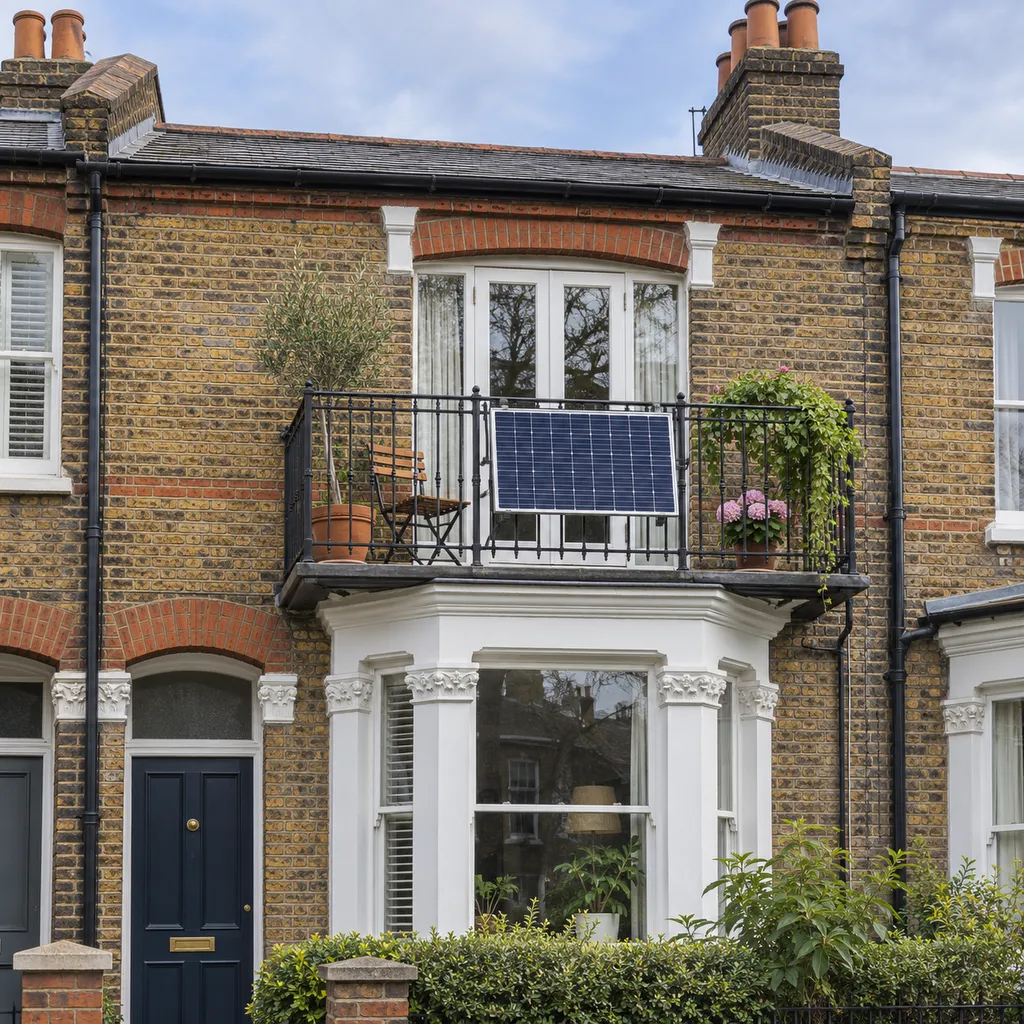
England: since 27 August 2026, SI 2026/896 brings plug-in solar under permitted development, so it needs no planning application if it meets the conditions 12. On walls and balcony or roof-terrace railings it can stick out at most 0.4 m, or 0.2 m if it faces a highway. It doesn’t apply to listed buildings (houses or flats), monuments, timber walls, balconies or fences, or timber-clad façades; in conservation areas and World Heritage Sites, walls, balconies and railings facing a highway are excluded too 12.
Wales and Scotland: the electrical change (SI 2026/848) applies 1. Planning is devolved and we haven’t found any specific change for plug-in solar, so ask your council. SI 2026/896 has ‘England’ in its title but says it ‘extends to England and Wales’, so its reach in Wales isn’t clear 12.
Northern Ireland: the ESQCR (NI) 2012 and G98/NI haven’t been amended. The IPS says its application there ‘is subject to further consideration’ 4, and the consultation said it would depend on the relevant Northern Ireland department 16. Which? advises Northern Ireland residents to wait 13.
Export payments, VAT and grantsUnder review
Export payments: for solar up to 50 kW, the Smart Export Guarantee (SEG) requires a certified installation and installer, usually MCS (or equivalent), plus a smart meter that measures exports 15. Which? says plug-in kits can’t currently be paid for exported power 13. We’ve found no official DESNZ or Ofgem document on plug-in solar and the SEG, and the government response doesn’t commit to reforming it 3. So ‘no SEG’ is a conclusion, not an official ruling.
VAT: the 0% rate applies to installing energy-saving materials, solar panels included, until 31 March 2027, rising to 5% from 1 April 2027. Supplying them without installing them is standard-rated 14. So a kit you buy to fit yourself would pay 20% VAT, but that’s an inference from VAT Notice 708/6: HMRC hasn’t ruled on plug-in solar specifically.
Grants: we’ve found no official grant specifically for plug-in solar, and the government’s 26 August 2026 press release mentions none 7. The saving comes only from using the power yourself: the government talks of up to about £110 a year 7.
This is information, not legal advice
This page summarises official and other sources as reviewed on 6 November 2026. It isn’t legal, electrical or financial advice, and the rules are still changing.
Before you buy or install, check the current sources, ask an electrician about your wiring and get permission from whoever has to give it. This site doesn’t sell kits and isn’t linked to any brand.
What is about to change
- One per circuit: the government wants to move from one device per household to one per circuit with its own breaker, but that needs a further G98 change, not yet made and with no date 345.
- Permanent standard: the IPS is interim. The government will start work on a long-term standard, with no timetable or designated BSI standard yet 34. The 2,000 W panel limit and the MCB + RCD option are also under review 34.
- Batteries: still excluded; the government ‘will continue to consider the evidence base’ 3.
- Northern Ireland: waiting on the Northern Ireland department, with no date 416.
- VAT: the 0% rate on professional installation ends on 31 March 2027 and becomes 5% from 1 April 2027 14. It doesn’t affect a kit you fit yourself.
Before you buy
- Check you live in England, Wales or Scotland. In Northern Ireland, wait.
- Buy a complete kit that declares IPS v2.0 compliance and is listed as compliant on the ENA register. Be wary of online marketplaces.
- Get an electrician to check your wiring and RCD/RCBO protection (type A, B or F and bidirectional, not type AC), especially if you still have old fuses.
- If you rent or are a leaseholder, get written permission from your landlord or freeholder. Check planning: no timber balconies or cladding, no listed buildings, and take care in conservation areas.
- Plan the socket: plug straight into an ordinary socket, never an extension lead or adaptor, not on lighting or fixed-appliance circuits, and only one kit per household.
- Notify your DNO and tell your home insurer.
Sources
- legislation.gov.uk — SI 2026/848, The Plugs and Sockets etc. (Safety) Regulations 1994 and Electricity Safety, Quality and Continuity Regulations 2002 (Amendment) Regulations 2026official
- GOV.UK (DESNZ) — Plug-in solar: Regulatory amendment and interim product specification (consultation and outcome)official
- DESNZ — Plug-in solar: government response (July 2026)official
- DESNZ — Plug-in Solar Device Interim Product Specification, version 2.0 (July 2026)official
- Ofgem — Decision to Approve DCRP/MP/26/02: Proposed Amendment to facilitate Plug-in Microgeneration (11 August 2026)official
- GOV.UK — Government to make plug-in solar available within months (24 March 2026)official
- GOV.UK — Households can save as plug-in solar panels come to market (26 August 2026)official
- IET — IET urges households to check electrical safety before using plug in solar products (24 March 2026)
- IET — Plug-in solar PV position paper (2026)
- IET — Joint statement from ECA, Electrical Safety First, the IET, NICEIC and SELECT on plug-in solar panels (9 June 2026)
- Electrical Safety First — Plug-in Solar Panels: Knowing the risks and how to reduce them, v1.0 (August 2026)
- legislation.gov.uk — SI 2026/896, The Town and Country Planning (General Permitted Development) (England) (Amendment) Order 2026official
- Which? — Plug-in solar panels: everything you need to know (16 September 2026)
- HMRC — VAT on energy-saving materials and heating equipment (VAT Notice 708/6)official
- MCS — Smart Export Guarantee
- DESNZ — Plug-in Solar Consultation (consultation document, 16 June 2026)official
- Homebuilding & Renovating — Will your home insurance cover plug-in solar panels? (17 September 2026)