What’s in the kit
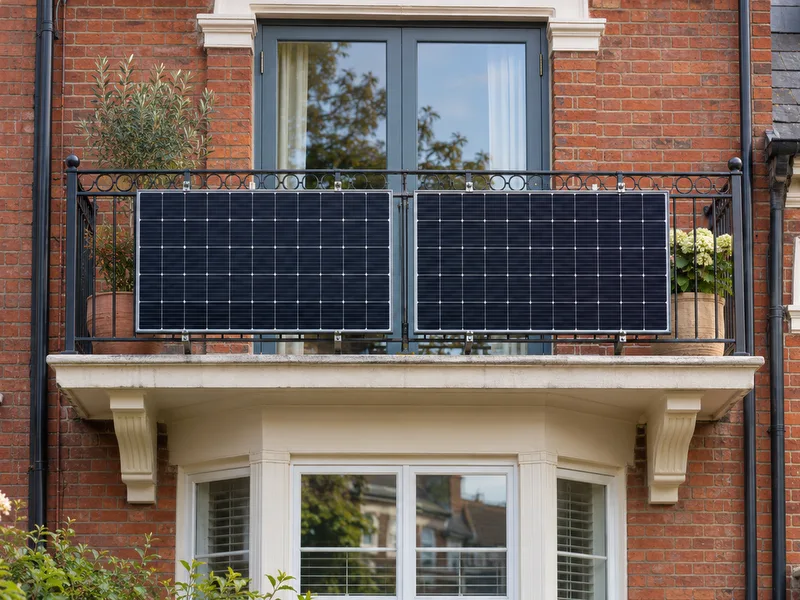
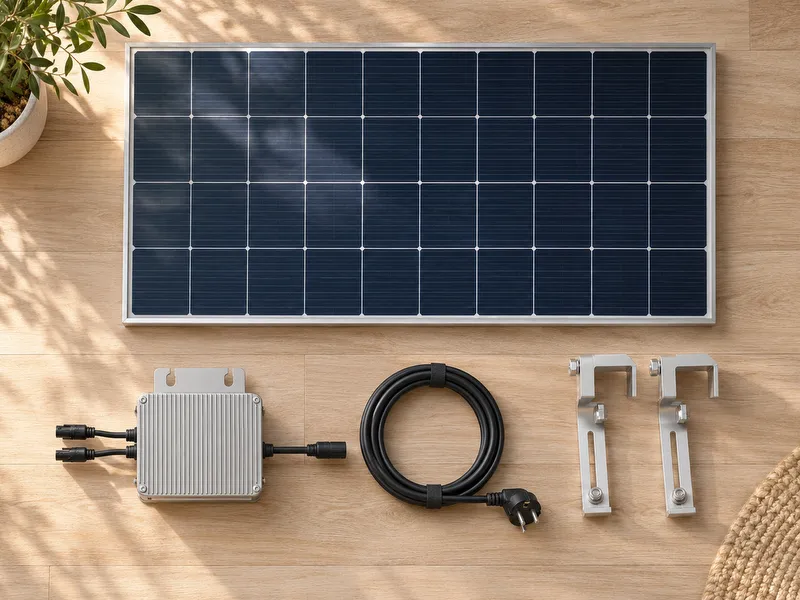
Panels: one or two (sometimes four flexible ones) of around 400–500 Wp each, monocrystalline; many are n-type TOPCon, often bifacial glass-glass. One datasheet example: the JA Solar JAM54D40 (435–460 W) measures 1762 × 1134 × 30 mm and weighs 22 kg 1. The Verbraucherzentrale gives ~1.1 × 1.8 m and over 20 kg per panel as typical 2.
Microinverter: converts the panels’ direct current (DC) into alternating current (AC) and synchronises it with the grid. Typical output is 600 or 800 VA, with 2 MPPT inputs. Datasheet examples: APsystems EZ1-M (600/799 VA, 96.7% peak efficiency, IP67, 12-year warranty according to the datasheet) 3 and Hoymiles HMS-800W-2T (800 VA, 3.48 A, IP67, 96.7% peak) 4; the Hoymiles figures come from distributors, not an official datasheet.
AC cable and plug: in Germany, DIN VDE V 0126-95 (in force since 1 December 2025) requires a cable of at least 5 m fitted by the manufacturer, and the inverter must stop generating when the plug is pulled, within 100 ms at most 56. In the UK, the official specification requires a moulded BS 1363 plug with a BS 1362 fuse of no more than 5 A and sleeved pins 7.
Mounts: railing hooks or clamps, wall brackets, or tilted triangular frames for the floor or a flat roof. In Stiftung Warentest’s 06/2025 test (8 kits of 800 W), 5 failed, almost always because the mounts weren’t stable enough, not because of the panels or the inverter 8. We know these results from press reports; the full report is paywalled.
How it works
The electricity from the panels enters your home’s wiring through the socket and is used first by whatever appliances are running at that moment (instant self-consumption). The meter only records the difference.
Whatever isn’t used at that instant flows to the grid, usually with no payment: in Germany this surplus is recorded as ‘unvergütet’, with no tariff 2. In Spain and France the legal position of the surplus is different and we haven’t yet confirmed it in official sources; the country rules pages cover it.
So what you mainly save on is your base load (fridge, router, standby devices, pumps…) and daytime use. If you’re out all day, you’ll use less of it.
How much an 800 Wp kit produces in a year
The figures in the table are our own calculation, run on 6 November 2026 with PVGIS, the European Commission JRC’s tool 9. Settings: 0.8 kWp, 14% losses, free-standing mounting, SARAH3 data 2005–2023, terrain horizon on, no local shading.
As a rule of thumb: in southern Europe, ~1250–1350 kWh a year with tilted panels or ~850 kWh hung vertically on the railing; in central and northern Europe, ~700–900 kWh tilted or ~520–650 kWh vertical.
This fits other sources: the Verbraucherzentrale estimates 280 kWh a year for one 400 W panel mounted vertically and unshaded on a south-facing balcony in Germany 2, so ~560 kWh for 800 W, close to the 599–650 kWh PVGIS gives for Germany and Poland. If the panel sits flat against the wall (less ventilation), our calculation drops by ~3–5%: in Berlin, 811 instead of 839 kWh (south 30°) and 596 instead of 612 kWh (south vertical).
| City | South 30° | South vertical (90°) | East vertical | West vertical |
|---|---|---|---|---|
| Seville | 1334 | 856 | 636 | 635 |
| Madrid | 1288 | 863 | 636 | 592 |
| Barcelona | 1247 | 846 | 559 | 594 |
| Paris | 910 | 651 | 462 | 443 |
| Munich | 904 | 650 | 446 | 445 |
| Berlin | 839 | 612 | 427 | 416 |
| Warsaw | 834 | 599 | 422 | 411 |
| London | 808 | 594 | 417 | 399 |
| Manchester | 704 | 517 | 367 | 355 |
How much you use without a battery
Finanztip, using HTW Berlin’s Stecker-Solar-Simulator, works through this case: a household using 3000 kWh a year, 2 panels (up to 1000 W) at 70° on a south-facing balcony. Result: 858 kWh a year generated, of which 490 kWh is used in the home, i.e. 57%. With a 2 kWh battery it would be 770 kWh, or 90% 1011.
The Verbraucherzentrale gives another example: 400 W vertical, facing south, generates 280 kWh and cuts grid consumption by about 200 kWh (≈71%) 2. The Umweltbundesamt notes that with small systems the self-consumption share ‘tends to be very high’, because output is small compared with household consumption 12.
HTW doesn’t publish a single ‘typical’ figure: it offers a simulator, not a table 11. As a rough guide, our own estimate (not a measurement): ~50–75% with 1 panel and ~45–65% with 2 panels in an average household; less in small households or homes empty during the day.
Lifespan and degradation
Current TOPCon panels typically carry a linear power warranty of −1% in the first year and −0.4% a year up to 30 years, meaning at least 87.4% of the power after 30 years; that’s what the JA Solar JAM54D40 datasheet states 1. The product warranty (defects) varies by model and market: 12, 15 or 25 years 1.
The APsystems EZ1 microinverter has a 12-year warranty according to its datasheet, and some distributors offer an extension 3.
Finanztip assumes at least 15 years of operation and says the panels often last another 15; the inverter may need replacing 10.
Basic electrical safety
No extension leads or multi-way adaptors. DIN VDE V 0126-95 doesn’t allow multi-socket strips, because of the risk of overloading the circuit and of a delayed disconnection 56; the Verbraucherzentrale calls them dangerous 2. The UK specification requires a warning not to connect to extension leads, multi-way adaptors or RCD adaptors 7. Simple rule: one device, in a fixed socket 2.
Circuit load. A short HTW Berlin report (02/2025) looks at the worst case: a circuit already carrying a continuous 18.08 A could in theory reach 21.6 A (135% of its rating) with 800 W fed in; even so, it concludes that between 800 and 2000 W there’s no significant effect on electrical safety 13. In practice: don’t plug it into a circuit that’s already at its limit (oven, tumble dryer, heaters).
RCD. The UK specification has a section on the effect on RCDs 7, and the DKE requires that feeding in doesn’t compromise existing protective devices 6. Our advice, not a rule: make sure your wiring has a working RCD and, if it’s old, have an electrician check it.
Mounting, wind and the risk of falling
A panel of over 20 kg falling from a balcony is a danger to others. The Verbraucherzentrale stresses that wind must not damage or loosen it and that both the location and the mounts must be suitable 2. In Stiftung Warentest’s 06/2025 test, 5 of 8 kits failed on mount stability; in one case the mount punctured a panel 8.
Watch out for shade too: according to the Verbraucherzentrale, just a few per cent of shading can cut output by more than 50% 2.
The UK specification is the most specific about mounting 7:
- The mounting system is part of the kit.
- It must not be fixed only with cable ties, rope, adhesive tape, bungee cords or straps.
- Wind and snow loads to Eurocode 1 (BS EN 1991-1-4 and BS EN 1991-1-3).
- It must not be installed on timber balconies or on façades with ACM, MCM, HPL or timber cladding.
What’s different in Germany and the UK
Germany: a maximum of 800 W per meter 2. With a household (Schuko) plug, DIN VDE V 0126-95 allows up to 960 Wp of panels and 800 W of inverter 52; the law (EEG) allows up to 2000 Wp. Surplus fed into the grid isn’t paid for 2.
UK: legal since 27 August 2026, under SI 2026/848 and the DESNZ specification v2.0 71415. Until G98 is amended, it’s one device per household 714. Up to 2000 W DC is allowed, but from 960 W a professional check of the wiring is recommended 7. According to the government, the microgeneration registration process is ‘still evolving’ 15.
The details for each country are on the country rules pages.
Spain, France and Poland: rules not yet confirmedUnder review
Spain: there’s no specific rule for plug-in kits; the self-consumption regulation RD 244/2019 applies. Secondary sources say you need zero-export mode or registration with a CIE (electrical installation certificate), and registration is handled by each region. We haven’t verified this in official sources.
France: several sources say you need a CACSI with Enedis (free, online), that ‘no feed-in’ means under 10 W on average over 30 minutes, and that NF EN 50549-10 is mandatory from 1 July 2026; some say NF C 15-100 advises against connecting to a socket. The legal references contradict each other.
Poland: sources disagree on whether you have to notify the distribution system operator (OSD) for kits up to 800 W, and we found no official source (URE or OSD).
Before you buy, check your country’s rules page.
Sources
- JA Solar – JAM54D40 LB BF
- Verbraucherzentrale – Steckersolar: Solarstrom vom Balkon direkt in die Steckdose
- APsystems – Microinverter EZ1-S / EZ1-M for EMEA, Datasheet
- pvundso.de – Hoymiles HMS-800-2T (distributor)
- ADAC – Balkonkraftwerke: DIN-Norm DIN VDE V 0126-95 (21.01.2026)
- DKE – Normauslegung zur DIN VDE V 0126-95official
- DESNZ – Plug-in Solar Device Interim Product Specification v2.0 (July 2026)official
- photon.info – Stiftung Warentest: Zwei Balkonkraftwerke sind gut, fünf mangelhaft (Test 06/2025)
- JRC – PVGIS, API non-interactive serviceofficial
- Finanztip – Balkonkraftwerk (Stand 19.11.2025)
- HTW Berlin – Stecker-Solar-Simulator
- Umweltbundesamt – Steckersolargeräte (Balkonkraftwerke)official
- HTW Berlin – Kurzbericht Steckersolar 800 W (Bergner, 02/2025)
- legislation.gov.uk – SI 2026/848official
- GOV.UK – Households can save as plug-in solar panels come to market (26 August 2026)official